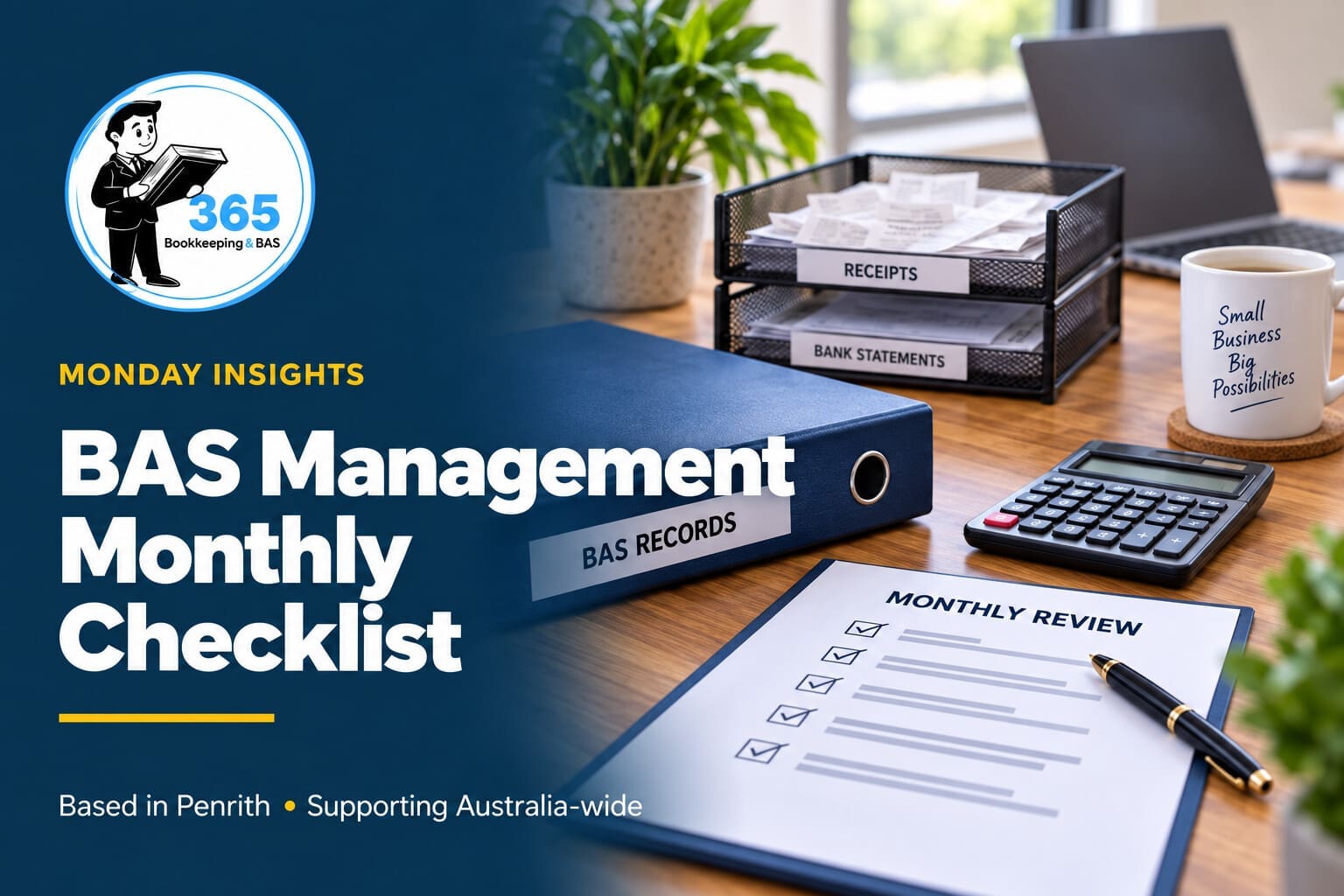
Monthly BAS checklist: a practical guide for small businesses
MONDAY INSIGHTS
BAS management works best as a regular routine—not a last-minute task.
For many Penrith businesses, the clearest BAS starts with reconciled records, a review of the unusual items and a simple approval process before anything is lodged.
“BAS management” can sound like one job at the end of a quarter. In practice, it is the ongoing work that makes your GST, PAYG withholding and other activity-statement figures easier to check and explain. When the records are kept current, you are less likely to be sorting through missing invoices or unexplained bank transactions near a deadline.
This guide explains the practical checks behind a more controlled BAS process. It is useful whether you handle the day-to-day record keeping yourself or work with a bookkeeper and registered BAS agent.
In short, BAS management comes down to four monthly habits: keep documents moving, reconcile and review the coding, check payroll, then prepare, approve and keep the workpapers before anything is lodged.
What BAS management should cover
The exact labels on a business activity statement depend on your registrations and circumstances. A sound process starts with the underlying accounting records rather than trying to work backwards from a BAS total.
- Bank and card reconciliations: match transactions to the bank statement and identify anything that is still unexplained.
- Sales review: confirm income is recorded once, refunds are treated consistently and the GST treatment reflects the actual supply.
- Purchases and receipts: collect supporting records, check supplier tax invoices where required and review the GST code before relying on it.
- Payroll review: reconcile wages, withholding and super-related records with the payroll system and payment evidence.
- Exception review: investigate new loans, asset purchases, owner drawings, private-use amounts, refunds and other unusual transactions before lodgement.
Keep the source documents connected
Cloud accounting software is useful only when the transactions, invoices and approvals can be followed. A receipt image alone may not explain why an expense was incurred or whether its GST treatment is right. Give the person reviewing the BAS enough context to ask a sensible question.
A practical monthly BAS-management checklist
This is a monthly records-review routine, not a recommendation to change how often you lodge your BAS. Follow the reporting cycle and due date that apply to your business.
1. Keep documents moving during the month
Set one method for bills, receipts and sales records to reach the accounting file. Avoid holding paper in a drawer until the BAS period ends. If a transaction is personal, reimbursed, partly private or connected with another entity, flag it early instead of hoping its bank description will be enough. Our checklist of what records you need for your BAS lists what to collect.
2. Reconcile and review the coding
A completed bank reconciliation is not a guarantee that every transaction is coded correctly. Look at the larger and unusual entries, new suppliers, refunds and transactions posted to clearing or suspense accounts. This is where a short monthly review saves time later. If you’d rather hand this over, our bookkeeping in Penrith service includes bank and credit-card reconciliations at your plan’s frequency.
3. Check payroll before the BAS is prepared
If you employ staff, compare payroll reports with the accounting file and payment records. Confirm the relevant pay run period, wages expense, PAYG withholding and any correction journals are understood. Payroll and BAS figures often become confusing when a pay run is posted after a period-end review without the records being updated.
4. Prepare, approve and retain the workpapers
Before a BAS is lodged, the business owner should be able to understand the key figures, outstanding questions and payment amount. Keep the reconciliations and documents that support the lodged statement so the next review starts from a known position.
Problems that often make BAS work harder
- Leaving bank feeds unreconciled for months.
- Claiming GST from a bank transaction without checking the underlying document.
- Mixing business and private spending without a clear process for recording it.
- Using clearing accounts that never get cleared.
- Recording income through more than one platform and not checking for duplicates.
- Assuming a software default tax code is correct for every transaction.
None of these automatically means a BAS is wrong, but they are all reasons to pause and investigate before lodging. If supplier documents are missing, our guide to missing tax invoices and GST credits explains what to check.
Preparing records and lodging a BAS are different jobs
Business owners can keep their own records and make decisions about their business. When you engage someone for a fee to provide BAS services, check whether they are appropriately registered or working under the supervision of a registered tax or BAS agent. You can use the Tax Practitioners Board public register to check registration.
At 365, our BAS services Australia-wide can include helping bring the accounting records into order, preparing the information for review and lodging where we are engaged and authorised to do so. The guide to who can lodge a BAS explains the distinction in more detail.
BAS management questions
What is BAS management?
It’s the ongoing work that keeps your GST, PAYG withholding and other activity-statement figures easy to check and explain, rather than one job at the end of the quarter.
If I review my records monthly, do I have to lodge my BAS monthly?
No. A monthly records review doesn’t change how often you lodge. Follow the reporting cycle and due date that apply to your business.
Who can prepare and lodge a BAS for a fee?
A registered BAS or tax agent, or someone working under their supervision. You can check registration on the Tax Practitioners Board public register.
Can 365 Bookkeeping and BAS help Penrith businesses with BAS?
Yes. As a BAS agent in Penrith, we can help bring your records into order, prepare the information for your review and lodge where we’re engaged and authorised to do so.
Support for Penrith businesses
If you are looking for a bookkeeper in Penrith, begin with a clear picture of what is up to date, what is still outstanding and when the next BAS is due. We can then help set up a workable month-to-month routine that fits your software, payroll and approval process. You can also use our 2026–27 BAS due-date guide as a planning reference. For an ongoing service, see BAS management in Penrith from a registered BAS agent.
Want a clearer BAS process?
Bring your current records, upcoming due dates and questions about your software. We’ll talk through the work involved and the right support for your business.
Last reviewed 21 September 2026. General information only, not financial, taxation or legal advice. Your GST treatment and reporting obligations depend on your circumstances. For official guidance, see the ATO’s Business activity statements (BAS) guidance and the Tax Practitioners Board’s BAS services guidance.