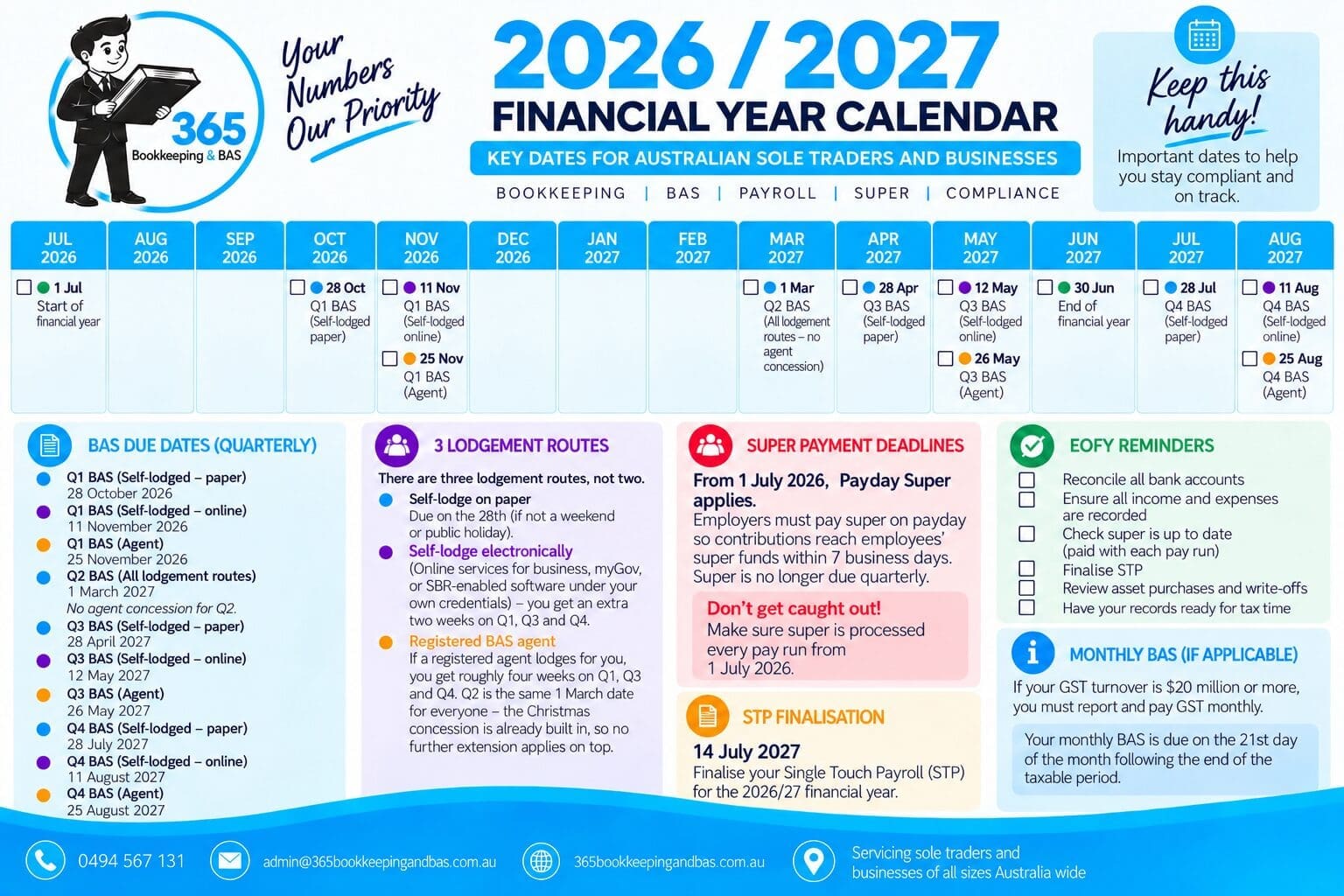
2026–27 BAS Due Dates and Business Compliance Calendar
IN THIS GUIDE
For the 2026–27 financial year, standard quarterly BAS due dates are 28 October 2026, 28 February 2027, 28 April 2027 and 28 July 2027. Monthly BAS is generally due on the 21st of the following month. The Q2 standard date, 28 February 2027, falls on a Sunday, so the ATO’s next-business-day rule applies. Eligible concessions can also affect your deadline: check the date on your BAS or ATO account.
What’s next (as at 16 November 2026): the Q1 (July–September 2026) online self-lodgement date of 11 November 2026 has passed. The registered BAS agent electronic lodgement date for Q1 is 25 November 2026, but eligibility is not automatic. Next is Q2 (October–December 2026), with a standard due date of 28 February 2027. Because that date is a Sunday, the next-business-day rule applies. There is no general two-week concession for Q2, and the registered BAS agent concession does not apply to Q2. Always check the date on your activity statement or in ATO online services.
2026–27 Quarterly BAS Due Dates
Businesses registered for GST may be required to lodge a Business Activity Statement (BAS) monthly, quarterly or annually depending on their circumstances.
Preparing your July–September BAS? Use our September quarter BAS checklist to get your records ready and check the lodgement dates that apply to your business.
For businesses lodging quarterly, the standard quarterly BAS due dates are:
| Quarter | Reporting period | Standard due date |
|---|---|---|
| Quarter 1 | July–September 2026 | 28 October 2026 |
| Quarter 2 | October–December 2026 | 28 February 2027 |
| Quarter 3 | January–March 2027 | 28 April 2027 |
| Quarter 4 | April–June 2027 | 28 July 2027 |
Weekend and public-holiday rules can change the actual deadline. Check the date on your activity statement or in ATO online services. Online and agent concessions apply only where eligible; Q2 does not receive the general two-week online concession.
These are the standard quarterly due dates. If a due date falls on a weekend or public holiday, you have until the next business day to lodge and pay. This applies to 28 February 2027, which is a Sunday. Confirm your applicable date on your BAS or ATO account. See the ATO guidance on BAS due dates.
Depending on how your BAS is lodged, additional time may be available.
Does Lodging Your BAS Online Give You More Time?
Eligible businesses lodging their own quarterly BAS electronically may receive an additional two weeks for certain quarters.
For the 2026–27 financial year, this generally means:
Quarter 1: 11 November 2026
Quarter 2: 28 February 2027 standard date (a Sunday; weekend and public-holiday rules apply) – no general two-week concession
Quarter 3: 12 May 2027
Quarter 4: 11 August 2027
The electronic concession generally applies to Q1, Q3 and Q4 rather than Q2.
Eligibility and individual circumstances can affect your actual deadline, so businesses should always check the due date displayed on their activity statement or ATO account.
BAS Due Dates When Using a Registered BAS Agent
Businesses using a registered BAS agent may be eligible for additional lodgment time under the ATO’s registered agent lodgment program.
Agent due dates can differ from the standard self-lodgment dates.
For 2026–27 quarterly BAS, dates differ by lodgement method. Standard self-lodgement: Q1 28 October 2026; Q2 28 February 2027; Q3 28 April 2027; Q4 28 July 2027. Eligible online self-lodgement: Q1 11 November 2026; Q2 no general two-week concession; Q3 12 May 2027; Q4 11 August 2027. Registered BAS agent electronic lodgement under the ATO’s BAS agent lodgment program: Q1 25 November 2026; Q2 not applicable; Q3 26 May 2027; Q4 25 August 2027 (to be confirmed when the 2027–28 program is developed). Agent concessions require statements generated after the previous statement was lodged electronically. Eligibility is not automatic: a first BAS or previous paper lodgement may mean an earlier date. Confirm your date on the activity statement or in ATO online services. Weekend or public holiday dates move to the next business day; 28 February 2027 is a Sunday.
Rather than assuming that using an agent automatically gives your business a particular extension, confirm the due date applicable to your individual activity statement with your registered BAS or tax agent.
365 Bookkeeping and BAS is operated by a registered BAS Agent and IPA Associate member, providing eligible businesses with BAS preparation and lodgment support.
Already past a due date? Our guide to lodging outstanding BAS explains what to do first and how overdue periods are brought up to date.
What Happens With Quarter 2 BAS?
Quarter 2 covers October to December.
Unlike the other quarters, Q2 does not receive the standard additional two-week electronic lodgment concession.
The standard Q2 BAS due date is generally 28 February.
Getting ready for the October–December BAS? Our checklist of what records you need for your BAS covers the documents to gather first.
This is worth remembering because businesses accustomed to receiving additional time for other quarterly activity statements can incorrectly assume the same extension applies to Q2.
Keeping track of BAS, payroll, superannuation and other reporting deadlines is an important part of running a business in Australia.
Missing a deadline can create unnecessary administration and, depending on the obligation, may result in interest, penalties or additional compliance requirements.
The 2026–27 financial year also introduces an important change for employers: Payday Super commenced on 1 July 2026, significantly changing how frequently employers need to pay employees’ superannuation.
This guide covers some of the key dates Australian sole traders and businesses should keep in mind throughout the 2026–27 financial year.
Save Our 2026–27 Financial Year Calendar
To make these dates easier to keep track of, we’ve created a 2026–27 Financial Year Calendar for Australian sole traders and businesses.
It includes key dates for:
- Quarterly BAS lodgments
- Online BAS lodgment concessions
- Registered BAS agent lodgment dates
- Payday Super
- STP finalisation
- End-of-financial-year reminders
- Monthly BAS obligations
Save the calendar to your phone or computer so you can refer back to it throughout the financial year.
Monthly BAS Due Dates
Some businesses report GST monthly rather than quarterly.
Businesses with GST turnover of $20 million or more generally need to report and pay GST monthly. Businesses below this threshold may also choose monthly reporting in certain circumstances.
Monthly BAS is generally due on the 21st day of the following month.
For example, an activity statement covering August would generally be due on 21 September.
Monthly lodgers don’t receive the standard two-week electronic lodgment concession available to eligible quarterly electronic lodgers.
Payday Super Started on 1 July 2026
One of the biggest payroll changes affecting Australian employers in the 2026–27 financial year is Payday Super.
Payday Super commenced on 1 July 2026.
Previously, many employers managed their Superannuation Guarantee obligations around quarterly payment deadlines.
That has changed.
Under Payday Super, employers generally need to make super contributions in connection with each payday, whether employees are paid weekly, fortnightly or monthly.
How Long Do Employers Have to Pay Super After Payday?
Although the system is called “Payday Super”, the important deadline is when the contribution reaches the employee’s super fund.
For most contributions, the employee’s super fund must receive the contribution within 7 business days after payday. Some circumstances have extended timeframes, including certain situations involving new employees.
This makes processing time particularly important.
Employers shouldn’t assume that initiating a payment close to the end of the seven-business-day period necessarily means the contribution has been received on time.
Why Payday Super Is Important for Employers
Payday Super makes superannuation a much more frequent payroll responsibility.
For an employer running fortnightly payroll, super is no longer something that can simply be reviewed and paid once each quarter.
Each pay cycle now needs an effective process covering:
Payroll → Super calculation → Super payment → Fund receipt → Error monitoring
This means employers should pay particular attention to:
- Correct employee super fund details
- Super calculations
- Payroll configuration
- Contribution processing times
- Rejected or returned contributions
- New employees
- SuperStream processing
- Payroll reconciliations
- STP reporting
An incorrect fund or membership detail can become more important under Payday Super because employers have a significantly shorter timeframe in which to identify and resolve contribution problems.
Don’t Wait Until Day Seven
From a payroll management perspective, employers should avoid treating seven business days as their normal processing target.
Processing super alongside or shortly after completing the pay run provides additional time to identify rejected payments or incorrect employee super details.
The objective should be to establish a repeatable payroll process where super is dealt with every pay cycle, rather than relying on the old quarterly routine.
Payday Super and STP Reporting
Payday Super also changes some payroll reporting requirements.
From 1 July 2026, employers need to include employees’ year-to-date qualifying earnings and super liability information in their Single Touch Payroll reporting each payday.
Businesses should therefore make sure their payroll software and processes have been updated appropriately for the new requirements.
The Small Business Superannuation Clearing House Has Closed
Another significant change from 1 July 2026 is the closure of the ATO’s Small Business Superannuation Clearing House.
Employers that previously used the service need an alternative SuperStream-compliant method for making employee super contributions.
This makes it particularly important for affected small businesses to ensure their new super payment process is functioning correctly.
STP Finalisation Deadline
Employers reporting through Single Touch Payroll generally need to complete their annual STP finalisation declaration by 14 July each year.
For the 2026–27 financial year, that means employers should prepare to finalise their payroll information by 14 July 2027.
Before finalising STP, employers should review employee year-to-date figures and make sure payroll records are complete and accurate.
End-of-Financial-Year Bookkeeping Checklist
The end of the financial year is also a useful opportunity to review the overall condition of your bookkeeping.
Before finalising the year, businesses should consider reviewing:
- Bank reconciliations
- Credit card reconciliations
- Income recorded
- Business expenses
- Accounts payable
- Accounts receivable
- Payroll records
- Superannuation records
- STP information
- Asset purchases
- GST coding
- Outstanding bookkeeping issues
Identifying discrepancies before BAS, payroll and year-end reporting is completed can make them considerably easier to resolve.
2026–27 Business Compliance Calendar
Some of the major dates to remember are:
1 July 2026 – Start of the 2026–27 financial year and commencement of Payday Super
28 October 2026 – Q1 standard quarterly BAS due date
11 November 2026 – Q1 electronic self-lodgment concession date where eligible
28 February 2027 – Q2 quarterly BAS standard due date
28 April 2027 – Q3 standard quarterly BAS due date
12 May 2027 – Q3 electronic self-lodgment concession date where eligible
30 June 2027 – End of the 2026–27 financial year
14 July 2027 – General STP finalisation deadline
28 July 2027 – Q4 standard quarterly BAS due date
11 August 2027 – Q4 electronic self-lodgment concession date where eligible.
The annual GST return is due 31 October, or 28 February following the annual tax period if the business is not required to lodge a tax return. See the ATO guidance on BAS due dates.
And for employers, remember that super is now an every-payday responsibility, with contributions generally needing to reach employees’ super funds within seven business days after payday.
BAS due date questions
The Q2 BAS (October to December 2026) has a standard due date of 28 February 2027. That date is a Sunday, so the next-business-day rule applies. Always confirm the date shown on your activity statement or in ATO online services.
No. The general two-week concession for eligible quarterly online self-lodgers applies to Q1, Q3 and Q4, not Q2.
Monthly BAS is generally due on the 21st of the following month. For example, an activity statement covering August is generally due on 21 September.
You may, if your business is eligible under the ATO’s registered agent lodgment program, but agent due dates can differ and an extension isn’t automatic. Confirm the due date for your activity statement with your registered BAS or tax agent.
Our guide to lodging outstanding BAS explains what to do first and how overdue periods are brought up to date.
Stay Ahead of Your Bookkeeping, BAS and Payroll Deadlines
Good compliance starts with accurate and up-to-date bookkeeping.
Leaving reconciliations, payroll discrepancies or BAS preparation until immediately before a deadline can make the process considerably more difficult.
365 Bookkeeping and BAS provides professional bookkeeping, payroll and BAS services to businesses in Western Sydney areas such as Penrith, Blacktown, Parramatta, Rydalmere and surrounding suburbs and all throughout Australia remotely.
Local support, Australia-wide reach
Explore our bookkeeping, payroll and BAS support in Penrith, Blacktown, Parramatta and Rydalmere. We also work with businesses Australia-wide through cloud accounting systems.
FREE 30-MINUTE CONSULTATION
Looking for a bookkeeper?
Discuss your bookkeeping, payroll or BAS requirements with us.